Gas vs Electric vs Induction Stoves: Complete 2026 Comparison
Updated: 6 Jul 2026
265
Gas stoves deliver unmatched real-time flame control, making them the top pick for experienced cooks. Electric ranges produce the most even oven heat and are easiest to clean. Induction cooktops boil water fastest, run coolest to the touch, and carry the strongest safety profile — at a higher upfront cost.
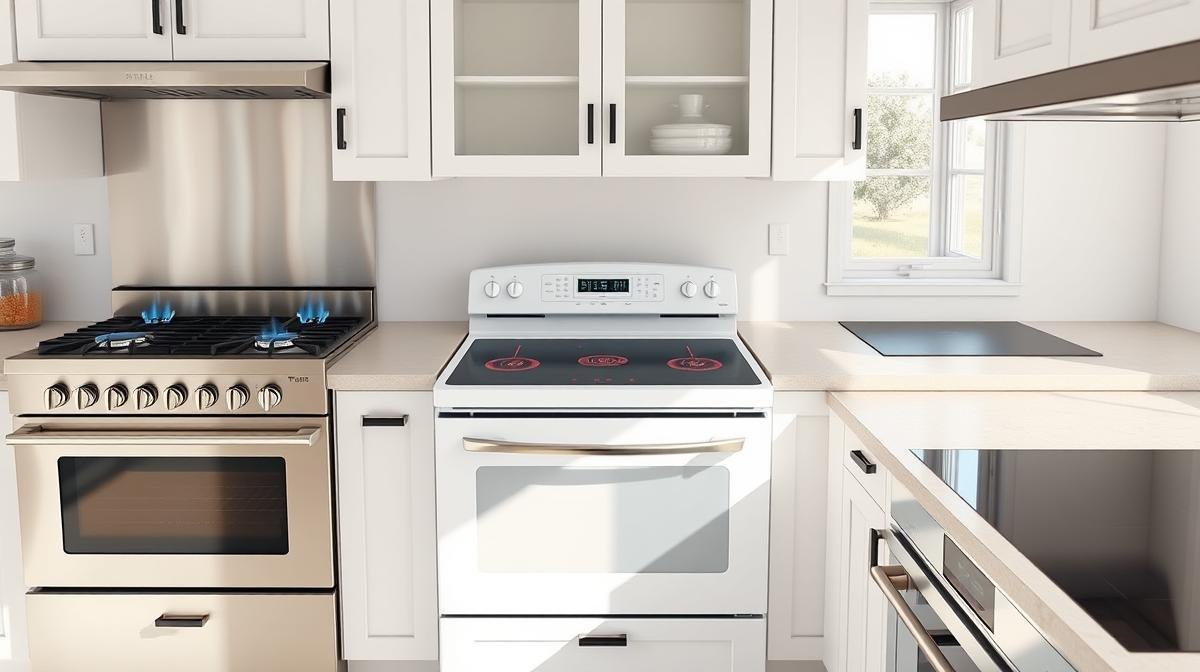
Overview & Quick-Reference Scores
Choosing between gas, electric, and induction comes down to your cooking habits, kitchen setup, and budget. Each technology has a distinct strength — and a real weakness. The scoring table below uses a 1–5 scale (5 = best) so you can see the trade-offs at a glance before diving into the detail.
| Criterion | Gas | Electric | Induction |
|---|---|---|---|
| Appliance Price | 4 | 5 | 3 |
| Cooktop Speed | 4 | 3 | 5 |
| Temperature Control | 5 | 3 | 5 |
| Oven Evenness | 3 | 5 | 4 |
| Cleaning Ease | 2 | 4 | 5 |
| Installation Cost | 2 | 4 | 3 |
| Safety | 3 | 4 | 5 |
| Energy Efficiency | 3 | 3 | 5 |
Scores are 1–5 (5 = best in category). Appliance prices assume mid-range models; scores reflect category-average performance, not individual brands.
Key Takeaway
No single stove type wins across every category. Gas leads on flame responsiveness, electric on oven consistency, and induction on speed, cleanliness, and efficiency. Identify your top two priorities from the table above, and the right choice becomes clear.
Cooking Performance
Gas: Instant Visual Feedback
Gas burners respond the moment you turn the knob. The visible flame lets you judge heat intensity without guessing, which is why most professional kitchens still rely on gas ranges. Adjusting gas stove flame mid-cook is intuitive — you see the change happen in real time. That immediacy is hard to replicate with any radiant-heat surface.
The downside is heat distribution. Round flames concentrate heat at the center of a pan, which can create hot spots on the outer edges. Wok cooking, however, benefits from this: the curved flame path wraps around the wok’s sides in a way flat surfaces cannot match.
If you cook on an LPG connection rather than natural gas, note that BTU output and flame behavior can differ noticeably — see our comparison of LPG vs PNG gas stoves for a deeper look.
Electric: Steady but Slow to Respond
Coil and smooth-top electric burners heat gradually and retain heat long after you lower the dial. That thermal lag makes maintaining medium heat on electric stoves a learned skill rather than an automatic one. Knowing simmer temperature on electric stoves — typically around 180–200°F — and dialing back the burner a notch or two in advance is the key technique.
Electric coil burners are the slowest of the three for boiling water, commonly requiring 8–10 minutes for a full pot, varies by model and element wattage. Smooth-top radiant surfaces are somewhat faster but still trail induction by a wide margin.
Induction: The Speed and Precision Leader
Induction works by generating an electromagnetic field that heats the pan directly — the glass surface itself stays relatively cool. According to U.S. Department of Energy energy efficiency guidance, induction cooking is approximately 5–10% more efficient than a gas burner and 3–5% more efficient than a conventional electric element at the point of use.
Manufacturer-rated boil times for a six-quart pot of water are commonly reported at 4–6 minutes on high-powered induction burners (typically 3,000–3,700W), compared to 8–10 minutes on electric coil and 7–9 minutes on gas. Exact figures vary by model, altitude, and starting water temperature.
Temperature control is as precise as gas — some argue more so, because digital settings hold a specific wattage output rather than relying on valve position. The requirement is compatible cookware: flat-bottomed pots and pans made of cast iron or magnetic stainless steel. Copper, aluminum, and most non-magnetic ceramics will not work without an induction-compatible base.
Tip: Test Your Cookware for Induction Compatibility
Hold a refrigerator magnet to the bottom of your pan. If it sticks firmly, the pan is induction-ready. If it slides off or doesn’t hold, that pan won’t work on an induction surface without an induction disc adapter (sold separately, though these reduce efficiency).
Oven Performance
The cooktop story flips somewhat when you look at the oven cavity. Electric ovens — especially those with a hidden lower bake element and a convection fan — produce the most consistent radiant heat throughout the cavity. Because electric elements cycle on and off to maintain temperature, and because there is no combustion byproduct in the air, moisture levels inside the oven stay more stable. Bakers in particular tend to favor electric ovens for consistent browning and crust development.
Gas ovens introduce moisture from combustion, which some cooks find beneficial for roasting but which can make achieving a crisp pastry bottom more challenging. The burner fires at the base and rises, so the oven cavity can have a temperature gradient of 25–50°F between the bottom and top rack — a variation commonly reported by bakers who rotate their trays mid-bake.
Induction ranges pair an induction cooktop with either an electric or, in some models, a dual-fuel configuration. The oven section in a standard induction range is effectively an electric oven, so oven performance matches the electric category above. The combination of an induction cooktop with an electric oven is increasingly popular in all-electric kitchens.
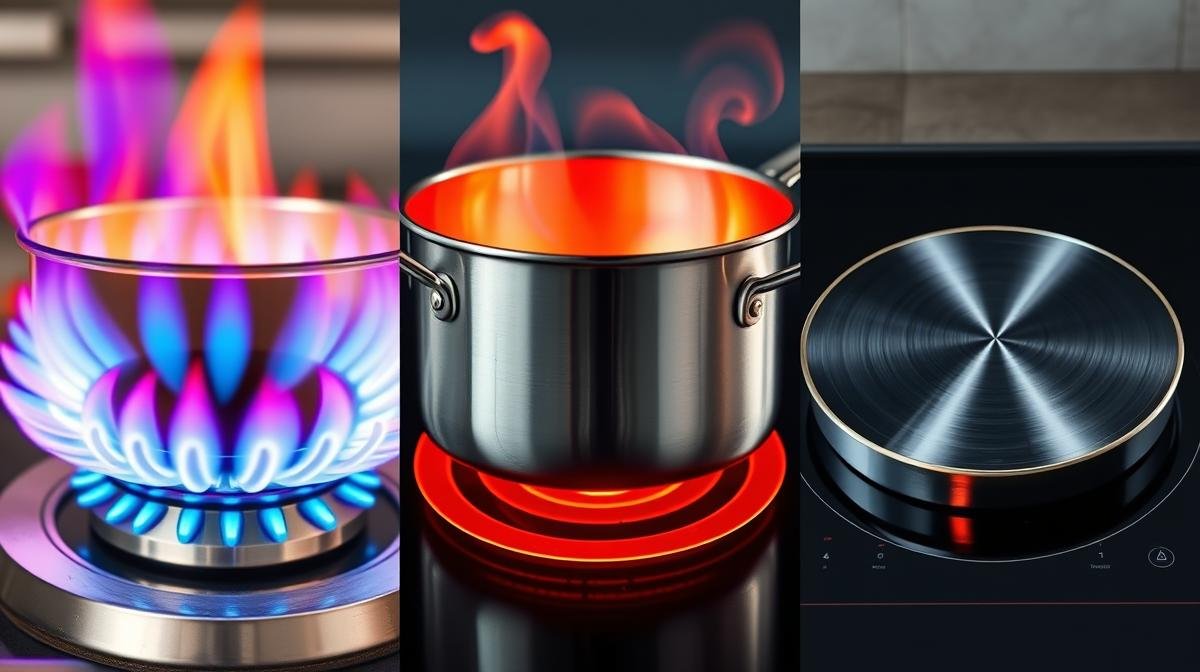
Installation & Cost
Gas Installation
If your kitchen already has a gas line, swapping a gas range is relatively straightforward. If you are converting from electric to gas, expect to pay for a new gas line run — commonly quoted at $200–$1,000+ depending on line length, local labor rates, and whether permits and inspections are required. The American Gas Association notes that professional installation and inspection of gas appliance connections is required by code in most U.S. jurisdictions. Factor in an annual leak check as a maintenance cost.
Appliance prices for a mid-range gas range (30-inch, free-standing) run roughly $600–$1,200. High-BTU professional-style ranges can exceed $3,000.
Electric Installation
Electric ranges require a dedicated 240V, 50-amp circuit. Many homes built in the last 30 years already have this outlet behind the range. If yours does not — or if you are adding a range to a kitchen that previously had none — an electrician typically charges $200–$500 to run the circuit and install the outlet, though costs vary by region and panel capacity.
Mid-range electric ranges (smooth-top, 30-inch) commonly retail between $500–$1,100. Electric stoves carry the lowest average appliance price of the three types.
It is worth checking your electric stove safety guidelines post-installation to confirm the circuit is properly grounded and the range is correctly connected before first use.
Induction Installation
Induction ranges share the same 240V outlet requirement as electric ranges, so if you are swapping one for the other the electrical side is already handled. The appliance itself is typically the most expensive of the three: mid-range induction ranges run $900–$1,800, with premium models crossing $3,000+. Portable single-burner induction units are available for $40–$150 and plug into a standard 120V outlet — these are a practical way to trial induction cooking before committing to a full range.
Add a cookware budget if your current set is not induction-compatible. A four-piece induction-ready stainless steel set commonly costs $80–$300 depending on brand and thickness.
Safety Comparison
Safety profiles differ significantly across the three types, and it is one of the strongest arguments for or against each option depending on your household.
Gas stoves carry the highest inherent risk profile: an open flame, the possibility of gas leaks, and combustion byproducts (including carbon monoxide and nitrogen dioxide) released into the kitchen. The U.S. Consumer Product Safety Commission recommends that homes with gas appliances install both smoke and carbon monoxide detectors and maintain proper ventilation. Understanding gas stove explosion risks — most commonly caused by gas leaks, clogged burner ports, or misused aerosols near an open flame — is essential for safe use.
Electric stoves eliminate combustion risk, but the radiant surface stays hot for several minutes after being switched off, posing a burn hazard — especially for children and pets. Issues with electric stove temperature control (e.g., an element that fails to cycle off properly) can also increase burn risk. Residual heat indicators on modern smooth-top ranges partially address this.
Induction has the strongest safety profile of the three. Because the surface only heats magnetically compatible cookware, the glass itself remains close to room temperature during normal cooking — hot enough to cause discomfort if touched immediately, but not hot enough to cause the instant burns associated with a radiant element running at full power. There is no open flame, no combustion, and no gas leak risk. Induction is commonly recommended for households with young children or elderly residents for these reasons.
Warning: Gas Ventilation Is Not Optional
Nitrogen dioxide from gas burners can accumulate quickly in under-ventilated kitchens. Always run your range hood or open a window when cooking on gas — especially during longer cook sessions. A range hood vented to the outside (not recirculating) is the recommended standard for gas ranges.
Who Should Choose Each Stove
Choose Gas If You…
- Cook frequently and value instant visual control over flame intensity
- Already have a gas line in your kitchen (avoids conversion cost)
- Use a wok or large round-bottomed cookware regularly
- Cook over very high heat for searing, charring, or stir-frying
- Prefer cooking during power outages (gas works without electricity on most models)
- Are comfortable with ventilation requirements and annual maintenance checks
Choose Electric or Induction If You…
- Electric: Want the lowest upfront appliance cost with reliable oven performance for baking
- Electric: Are in an older home already wired for a 240V range and want a simple swap
- Induction: Prioritize cooking speed — boiling, searing, and rapid heat changes
- Induction: Have young children or elderly family members and want a cooler surface
- Induction: Want the easiest cooktop to clean (no grates, no burner rings, flat glass surface)
- Induction: Are targeting lower energy bills and own (or are willing to buy) compatible cookware
Frequently Asked Questions
Is induction faster than gas for boiling water?
Yes, in most cases. Manufacturer-rated times for induction are commonly reported at 4–6 minutes for a large pot of water at high power (3,000–3,700W), versus 7–10 minutes for equivalent gas and electric models. Exact results vary by pot size, starting water temperature, altitude, and burner wattage, so treat all published times as approximate comparisons rather than guarantees.
Can I use my existing pots and pans on an induction cooktop?
Only if they are made from a magnetic material. Cast iron and magnetic stainless steel are fully compatible. Copper, aluminum, glass, and most non-magnetic ceramics are not. The quick test: if a magnet sticks firmly to the base of the pan, it will work on induction. Many modern cookware sets are now labelled “induction compatible” on the packaging.
Which type is cheapest to run long-term?
It depends on your local utility rates, which vary by region. Induction transfers roughly 85–90% of consumed energy into the pan, compared to around 70–75% for smooth-top electric and 40–55% for gas (which loses a significant portion to ambient heat). Where electricity and gas prices are comparable, induction is typically cheaper to run. Where natural gas is significantly cheaper per BTU than electricity — which is common in many U.S. regions — gas can still be more economical despite its lower thermal efficiency. Check current rates from your utility providers before deciding.
Is it expensive to switch from electric to gas?
Switching from electric to gas requires running a new gas line to the kitchen if one does not already exist. This is commonly quoted at $200–$1,000+ depending on line length, permit requirements, and local labor rates. You will also need to cap the existing 240V outlet or convert the outlet for other appliance use. In contrast, switching from gas to induction or electric typically only requires ensuring a 240V outlet is present, which costs $200–$500 if it needs to be added.
Which stove type is safest for families with young children?
Induction is generally considered the safest for households with young children. The cooking surface does not heat up independently — it only generates heat in the pan itself — so accidental contact with the glass is far less likely to cause serious burns compared to a gas flame or a radiant electric element at full heat. There is also no open flame or combustion byproduct. That said, no stove is entirely hazard-free, and supervision of children near any active cooking surface is always recommended.
Please Write Your Comments