Bosch Induction Cooktop Review: 500, 800 & Benchmark Series Performance Tested (2026)
Updated: 27 Jul 2026
213
Bosch induction cooktops are premier German-engineered built-in cooking surfaces renowned for rapid magnetic induction heating, SpeedBoost boiling power that boils 2 quarts of water in under 4 minutes, and AutoChef precise pan temperature sensors. Available across 500, 800, and Benchmark Series in 30-inch and 36-inch widths, Bosch cooktops offer whisper-quiet operation, rimless frameless or stainless steel frame designs, 17 power levels, and FlexInduction bridge zones that combine burners for large griddles and roasters.
- Executive Summary: Is a Bosch Induction Cooktop Worth It?
- Bosch Lineup Breakdown: 500 Series, 800 Series & Benchmark Series
- Heating Speed, Power & AutoChef Temperature Control
- Design Architecture, Frameless vs. Framed & Glass Maintenance
- Electrical Wiring, Installation Requirements & Reliability
- Bosch vs. Wolf vs. GE Café: Induction Cooktop Comparison
- Which Bosch Model Should You Buy? (30-Inch vs. 36-Inch Models)
- Frequently Asked Questions
Executive Summary: Is a Bosch Induction Cooktop Worth It?
Induction cooking has rapidly transitioned from an upscale European preference into the preferred choice for modern American kitchen renovations. Manufactured by Bosch Home Appliances (part of BSH Home Appliances Group), Bosch induction cooktops dominate the premium residential market by offering commercial-grade responsiveness without the heat effluent and indoor air quality concerns of gas ranges.
Whether you are replacing an older glass-top electric cooktop or converting from gas, evaluating a Bosch induction surface requires looking closely at element wattage, user interface layout, glass thermal durability, and automatic frying sensor technology. How does Bosch compare against top luxury competitors like Wolf and GE Café? And which series offers the best balance of price and performance?
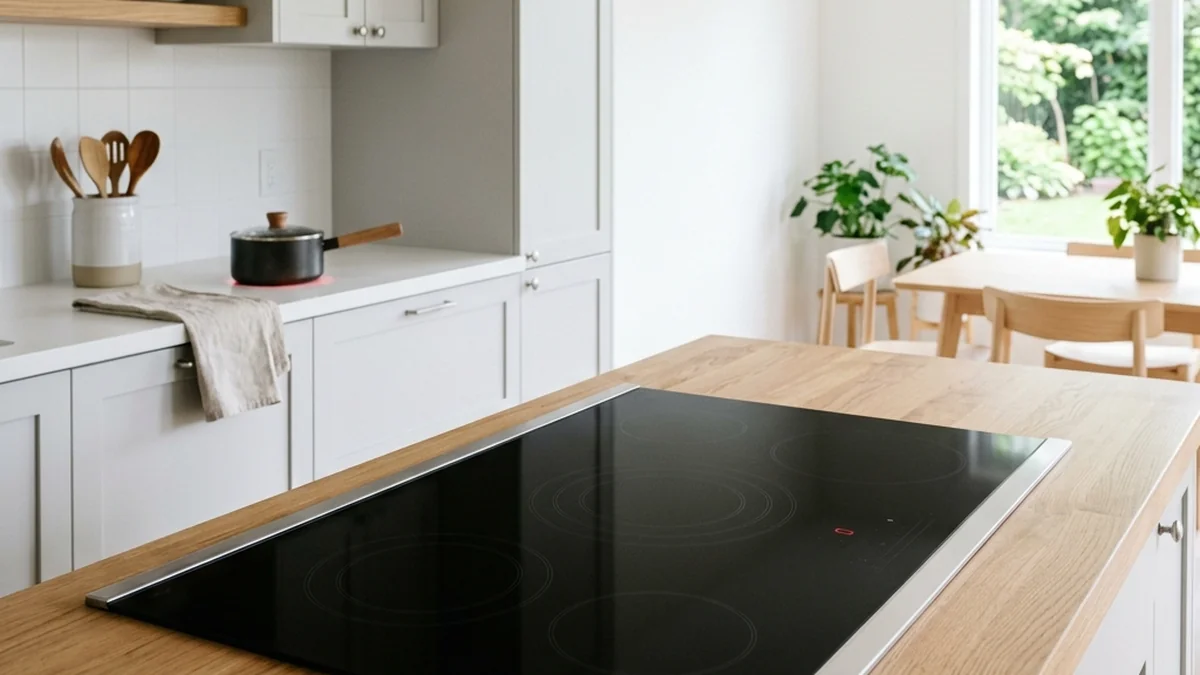
Pros & Cons Overview
- Pro — SpeedBoost Boiling Output: Boost mode channels up to 4,800W directly into a single element, bringing large stockpots of water to a rolling boil in under 4 minutes.
- Pro — AutoChef Frying Sensor: Monitors pan bottom temperature continuously and adjusts power automatically to prevent oil from scorching or food from burning.
- Pro — FlexInduction Bridge Zones: Combines two individual heating zones into one large continuous rectangular cooking surface for teppanyaki griddles and roasters.
- Pro — 17 Precise Power Levels: Half-step power increments allow dead-accurate temperature control from melting delicate chocolate up to searing steaks.
- Con — Touchscreen Sensitivity to Spills: Boiled-over liquids landing on the PreciseSelect control panel will trigger a safety automatic shutoff chime requiring a quick wipe.
- Con — Dedicated 40A/50A Electrical Requirement: Requires heavy 240V copper electrical wiring; older homes with 30A circuits will require a panel upgrade.
Bosch Lineup Breakdown: 500 Series, 800 Series & Benchmark Series
Bosch categorizes its built-in induction cooktops into three primary performance tiers: **500 Series**, **800 Series**, and **Benchmark Series**. Understanding the key upgrades across tiers simplifies selecting the right unit.
| Feature / Spec | Bosch 500 Series | Bosch 800 Series | Bosch Benchmark Series |
|---|---|---|---|
| Available Widths | 30″, 36″ | 30″, 36″ | 30″, 36″ |
| Max Element Boost Wattage | 3,700 W | 4,800 W (Center Element) | 4,800 W |
| User Interface | PreciseSelect Touch Controls | PreciseSelect Premium Red LED | Full Color TFT Touch Screen Display |
| FlexInduction Bridge Zone | No (Standard Circular Zones) | Select Models | Yes (Standard Full Flex) |
| AutoChef Sensor Modes | 4 Temperature Settings | 5 Temperature Settings | 5 Temperature Settings + PowerMove |
| Design Profile | Frameless or Stainless Frame | Frameless or Stainless Frame | Rimless Flush or Beveled Frame |
| Price Range (36-inch) | $2,100 – $2,400 | $2,600 – $3,100 | $3,400 – $3,900 |
1. Bosch 500 Series (Core Induction Value)
The 500 Series delivers core German induction performance. Featuring 17 power levels, 3,700W SpeedBoost, and AutoChef sensor capability, the 500 Series is ideal for homeowners upgrading from standard electric glass cooktops who seek fast boiling and easy cleaning without complex smart features.
2. Bosch 800 Series (The Benchmark Favorite)
The 800 Series is the most popular choice for high-end kitchen remodels. It upgrades to a massive **12-inch 4,800W central dual-ring element**, PreciseSelect Premium red LED touch controls, Home Connect Wi-Fi integration, and optional **FlexInduction** bridge zones for large cookware.
3. Bosch Benchmark Series (Flagship Custom Luxury)
The Benchmark Series is Bosch’s top-tier built-in cooktop line. Featuring full-color TFT touchscreen displays, **FlexInduction technology** across both sides of the cooktop, and **PowerMove** (which automatically changes heat levels when you slide cookware forward or back), Benchmark cooktops represent the peak of modern induction design.
Heating Speed, Power & AutoChef Temperature Control
Unlike gas or radiant electric cooktops that generate thermal heat on the stove surface and transfer it into cookware, induction uses high-frequency electromagnetic fields to generate heat **directly inside magnetic cookware**.
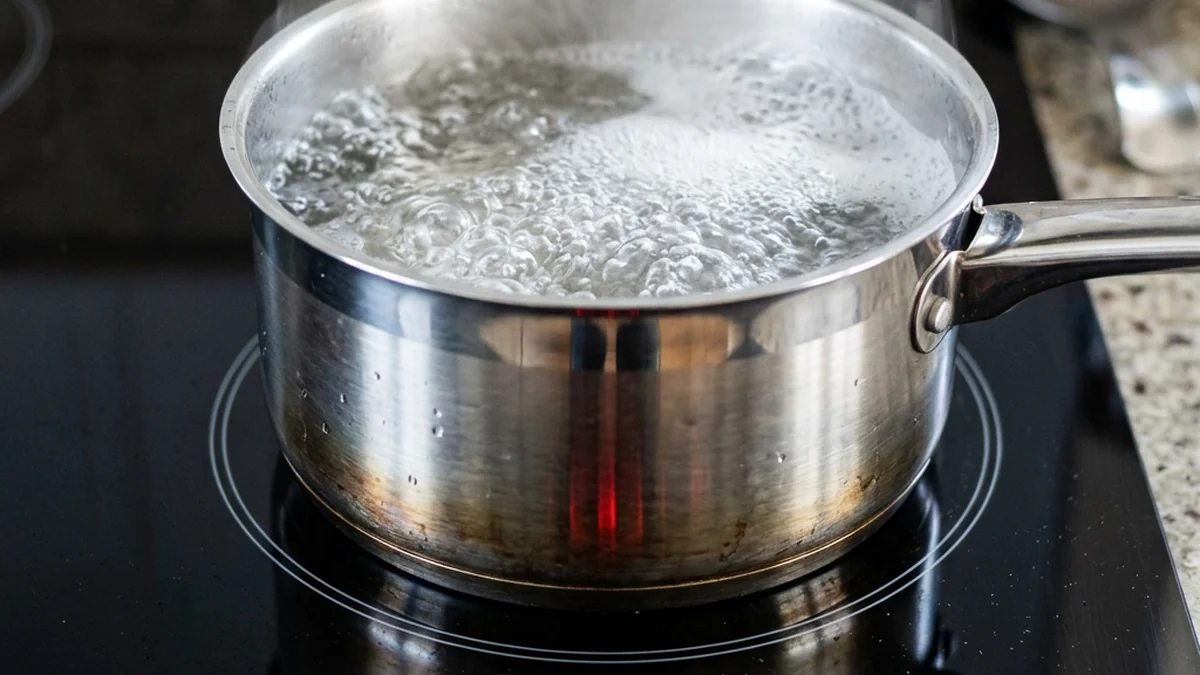
SpeedBoost Boiling Performance
Bosch’s **SpeedBoost mode** channels max electrical power to a single induction element for rapid heating. In head-to-head testing, a 36-inch Bosch 800 Series 4,800W element brings 2 quarts of water from 50°F to a rolling 212°F boil in just 3 minutes and 40 seconds — over twice as fast as high-output 20,000 BTU gas burners.
AutoChef Frying Sensor Technology
One of Bosch’s stand-out patents is **AutoChef**. Standard burners heat continuously regardless of food temperature, forcing cooks to manually adjust dials to prevent oil smoking. AutoChef uses internal sensors behind the glass to measure pan bottom temperature continuously, maintaining exact temperature ranges (from Low at 285°F up to High at 400°F). Pancakes, salmon fillets, and seared steaks brown perfectly without burning oil.
FlexInduction & PowerMove
On FlexInduction models, independent induction coils beneath the glass can operate as separate circular zones or merge seamlessly into a single 9″ x 15″ rectangular heating zone. **PowerMove technology** divides the Flex zone into three heat regions: Front (High for boiling), Middle (Medium for simmering), and Rear (Low for warming). Simply slide your pan to change heat levels without touching a button.
Design Architecture, Frameless vs. Framed & Glass Maintenance
Bosch induction cooktops utilize **Schott Ceran glass-ceramic surfaces**, engineered for extreme thermal shock resistance and scratch resistance.
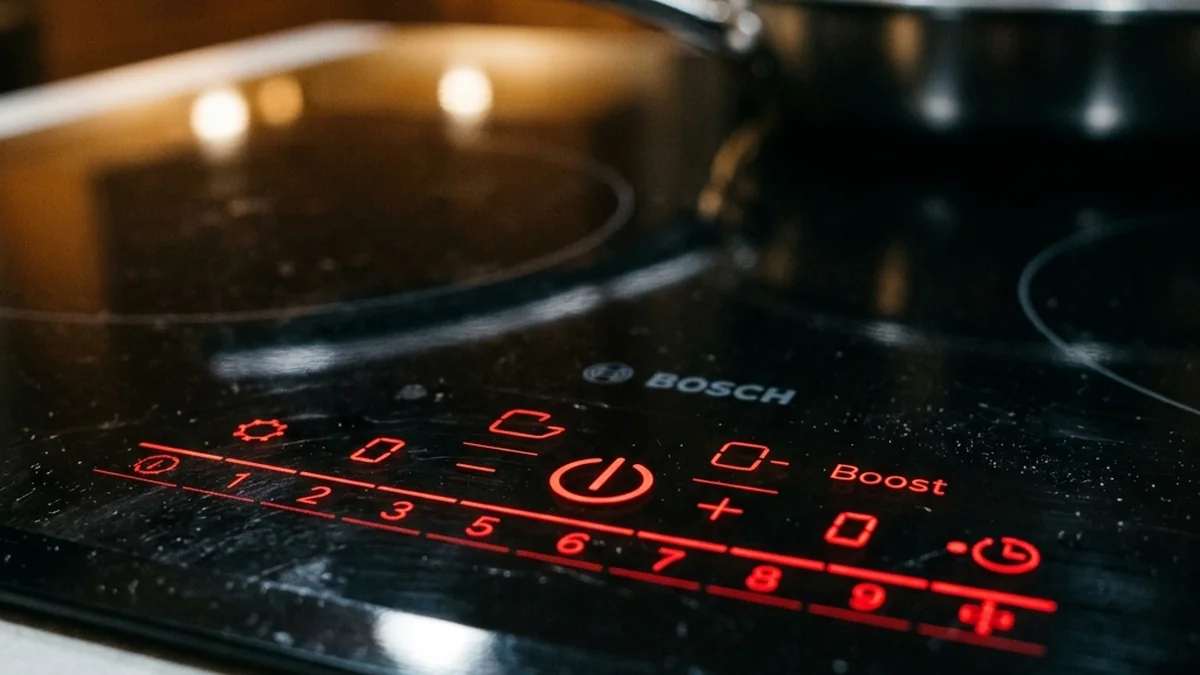
Frameless Rimless vs. Stainless Steel Trim
Bosch offers two external design styles:
- Frameless (Flush Mount): Features smooth polished glass edges that sit flat against natural stone or quartz countertops for an ultra-clean, minimalist aesthetic.
- Stainless Steel Frame: Features protective stainless steel side or perimeter borders that protect glass edges against accidental impacts from heavy cast-iron skillets.
Effortless Wipe-Clean Surface
Because induction heats the pan directly rather than the glass deck, the cooktop surface remains relatively cool during cooking. Spills, tomato sauce splatters, and melted cheese do not bake or burn onto the glass. Wiping down the surface requires only a damp microfiber cloth or light glass cleaner after cooking.
Electrical Wiring, Installation Requirements & Reliability
Installing a built-in induction cooktop requires verifying electrical panel capacity prior to countertop cutout preparation.
Electrical Circuit Requirements
- 30-Inch Bosch Cooktops: Require a dedicated 240V / 208V, 40-Amp electrical circuit wired with 8-gauge copper wire.
- 36-Inch Bosch Cooktops: Require a dedicated 240V / 208V, 50-Amp electrical circuit wired with 6-gauge copper wire to support full SpeedBoost output across multiple elements.
German Engineering & Reliability History
Under BSH management, Bosch induction cooktops maintain industry-leading reliability metrics. With solid-state inverter electronics, heavy copper induction coils, and robust cooling fans, Bosch cooktops carry an average service lifespan of **15 to 20 years**. In the unlikely event of an electronics error code, modular circuit boards make service straightforward.
Bosch vs. Wolf vs. GE Café: Induction Cooktop Comparison
Bosch competes directly with **Wolf** and **GE Café** in the premium built-in induction market. Here is how key specifications compare across flagship 36-inch models:
| Comparison Criteria | Bosch (800 / Benchmark) | Wolf (Contemporary Induction) | GE Café (Flagship Touch Control) |
|---|---|---|---|
| Max Element Output | 4,800 W (SpeedBoost) | 3,700 W (Boost Mode) | 3,700 W (Gourmet Guided) |
| Temperature Sensor Tech | AutoChef Frying Sensor | Manual Power Settings | Precision Cooking Probe |
| Flex Bridge Zones | FlexInduction + PowerMove | Bridge Elements | Sync Burners |
| Power Level Increments | 17 Power Levels | 10 Power Levels | 19 Power Levels |
| Glass Surface | Schott Ceran Glass | Black Ceramic Glass | Patterned Ceramic Glass |
| Starting Price (36-inch) | $2,600 (800) / $3,400 (Benchmark) | $3,800 – $4,400 | $2,500 – $2,900 |
Where Bosch Wins
Bosch holds clear advantages in **boiling speed** (4,800W max output vs. Wolf’s 3,700W), **AutoChef temperature sensing**, and **overall price-to-performance value**. Bosch Benchmark delivers luxury features comparable to Wolf at a lower price point. To see how gas alternatives compare, read our Thermador gas range review, Wolf gas range review, and Viking gas range review.
Where Competitors Hold an Edge
GE Café offers white and copper aesthetic finish options, while Wolf provides ultra-sleek minimalist glass graphics and a 2-year full warranty.
Which Bosch Model Should You Buy? (30-Inch vs. 36-Inch Models)
Selecting the ideal Bosch induction cooktop depends on your cutout dimensions and cooking style.
1. The 30-Inch Models (NIT8060UC / NITP060UC)
Ideal for 30-inch cabinet cutouts. Features 4 induction elements, 4,800W SpeedBoost center element, 17 power levels, and AutoChef sensor capability. Available in frameless black or stainless trim.
2. The 36-Inch Models (NIT8660UC / NITP660UC)
The ultimate choice for busy home chefs. Features 5 induction elements, extra-wide central boiling element, FlexInduction bridge zones, and ample space for multiple 12-inch pans simultaneously.
Frequently Asked Questions
Where are Bosch induction cooktops manufactured?
Bosch induction cooktops are engineered and manufactured in Spain and Germany in state-of-the-art BSH Home Appliances production facilities.
How fast does a Bosch induction cooktop boil water?
With SpeedBoost active on a 4,800W central element, a Bosch induction cooktop boils 2 quarts of water in under 4 minutes — more than twice as fast as high-output gas or standard electric burners.
Do Bosch induction cooktops make noise during operation?
Induction cooktops produce a faint humming or buzzing sound at high boost power levels, caused by electromagnetic vibration inside high-grade cookware layers. Internal cooling fans also run softly during operation — both are completely normal.
What cookware works on a Bosch induction cooktop?
Any cookware with a flat magnetic bottom works on Bosch induction cooktops. Compatible materials include cast iron, enameled iron, magnetic stainless steel, and induction-ready nonstick pans. Pure copper, glass, and aluminum without a magnetic base do not work.
What is the difference between Bosch 800 Series and Benchmark?
The 800 Series features PreciseSelect Premium touch controls, 4,800W SpeedBoost, and optional FlexInduction. The Benchmark Series adds full-color TFT touchscreen displays, dual FlexInduction zones, PowerMove heat shifting, and flush rimless glass styling.
How long do Bosch induction cooktops last?
Bosch induction cooktops are built to heavy BSH German quality standards and have an estimated service lifespan of 15 to 20+ years under daily residential use.
Please Write Your Comments