Breckwell Pellet Stove Review: High-Efficiency Biomass Heating & Real-World Reliability
Updated: 8 Sep 2026
66
As residential heating oil, propane, and grid electricity rates climb across North America, homeowners facing harsh winter freezes are increasingly turning toward autonomous biomass heating solutions. Among the legacy manufacturers in the alternative heating sector, Breckwell Pellet Stoves have maintained a commanding presence since their founding in 1980. Renowned for their heavy-gauge steel construction, cast iron fireboxes, and industrial-grade mechanical components, Breckwell stoves bridge the gap between utilitarian workshop workhorses and refined living room hearth centerpieces.
Unlike traditional cordwood stoves that require continuous log hauling, splitting, stacking, and chimney sweeping, a modern pellet stove automates the entire combustion cycle. By feeding compressed sawdust pellets through an electric motorized auger into a forced-air burn pot, Breckwell units deliver continuous, thermostatically regulated heating outputs ranging from 40,000 to over 55,000 BTUs per hour. But with competing pellet brands like Quadra-Fire, PelPro, and Harman saturating the market, how does Breckwell’s flagship lineup—including the renowned Big E (P1000), P24 Executive, and P22 Maverick—perform in real-world heating efficiency, component longevity, electrical consumption, and day-to-day maintenance? In this comprehensive, technical review, we evaluate Breckwell’s engineering architecture, digital control boards, thermal performance, hopper endurance, and long-term reliability to help you determine if a Breckwell pellet stove is the right investment for your home.
- The Breckwell Lineup: Flagship Models & Heating Capacities
- Combustion Engineering: Auger Feed, Cast Iron Burn Pot & Airwash Glass
- Digital Control Board & Operating Modes: 1–5 Heat Levels vs. Thermostat Mode
- Thermal Efficiency, BTU Output & Square Footage Performance
- Hopper Capacities & Burn Times: From 45 lb Daily Fills to 120 lb Big E Endurance
- Routine Maintenance Protocol: Burn Pot Clinkers, Scraper Rods & Ash Pan
- Troubleshooting Common Breckwell Issues: Vacuum Switches, Auger Jams & E-Codes
- Head-to-Head Comparison: Breckwell vs. Quadra-Fire vs. PelPro
- Pros, Cons & Final Buying Verdict: Is a Breckwell Pellet Stove Worth It?
1. The Breckwell Lineup: Flagship Models & Heating Capacities
Breckwell designs and manufactures several distinct classes of biomass heaters tailored for varying architectural footprints, ranging from utility workshops and hunting cabins to expansive multi-story suburban homes. Their core models include:
- Breckwell Big E (P1000 / P1000I): The brand’s undisputed legendary bestseller. Originally engineered as an economical utility heater for basements and workshops, the Big E became a cult favorite for main living areas due to its colossal 120 lb hopper capacity, 55,000 BTU maximum heat output, and rugged no-frills steel chassis capable of warming up to 2,200 square feet for over 60 hours on a single fill.
- Breckwell P24 Executive (P24FS / P24I): The flagship decorative living room stove. Featuring an elegant bay-window design, gold or brushed nickel door trim options, full ceramic glass viewing, and a 50,000 BTU burner, the P24 combines premium aesthetics with a 60 lb hopper to heat homes up to 2,200 sq. ft.
- Breckwell P22 Maverick (P22FS / P22I): A compact powerhouse designed for mid-sized homes, townhouses, and cottages (up to 1,500 sq. ft.). Delivering 40,000 BTUs with a 45 lb hopper, the Maverick features a smaller footprint while sharing the identical digital control board and auger architecture of its larger siblings.
- Breckwell P4000 Sonoma: A contemporary cast-iron-styled freestanding pellet stove delivering clean lines, integrated convection side panels, and up to 42,000 BTUs of steady, radiant biomass warmth.
2. Combustion Engineering: Auger Feed, Cast Iron Burn Pot & Airwash Glass
The operational reliability of any pellet stove hinges entirely on its mechanical feeding and forced-air induction systems. Breckwell utilizes a bottom-to-top continuous auger drive powered by a high-torque 1 RPM or 4 RPM gearmotor. Pellets drop down a gravity-fed chute into a heavy, removable cast-iron burn pot situated directly above a dedicated electric hot rod igniter cartridge.
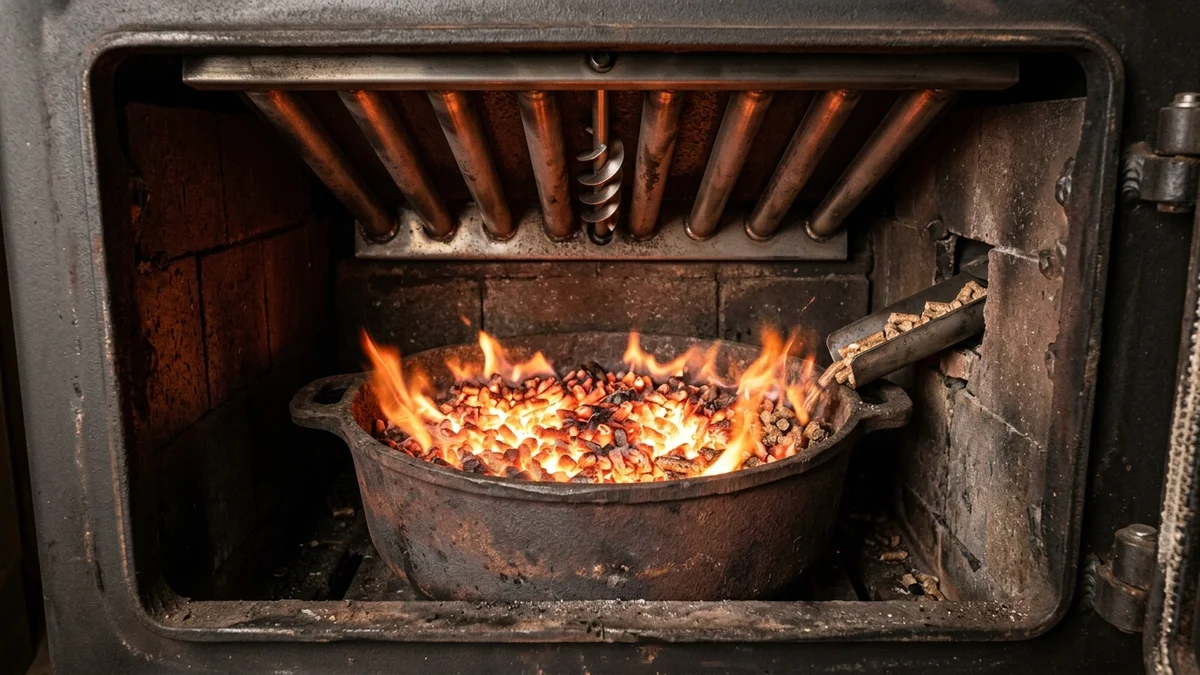
A high-velocity exhaust combustion blower (draft fan) draws negative pressure through the firebox, pulling fresh exterior combustion air up through the perforated holes of the burn pot. This creates an intensely oxygenated, torch-like flame that burns off volatile gases at temperatures exceeding 1,200°F (650°C). Above the firebox sits a bank of heavy stainless steel heat exchanger tubes. An integrated front-pull scraper rod allows homeowners to manually scrape fly ash off the heat exchanger tubes daily without opening the firebox door, maintaining peak heat transfer efficiency into the living space.
Additionally, Breckwell incorporates a preheated airwash manifold across the top of the ceramic glass door. A curtain of fresh air sweeps downward across the interior glass pane, significantly delaying the accumulation of soot and creosote so you can enjoy the mesmerizing flame view for days between cleanings.
3. Digital Control Board & Operating Modes: 1–5 Heat Levels vs. Thermostat Mode
Modern Breckwell stoves feature a standardized, microprocessor-controlled digital circuit board mounted flush to the stove side panel. The control panel simplifies operation through intuitive tactile pushbuttons and illuminated LED status indicators:
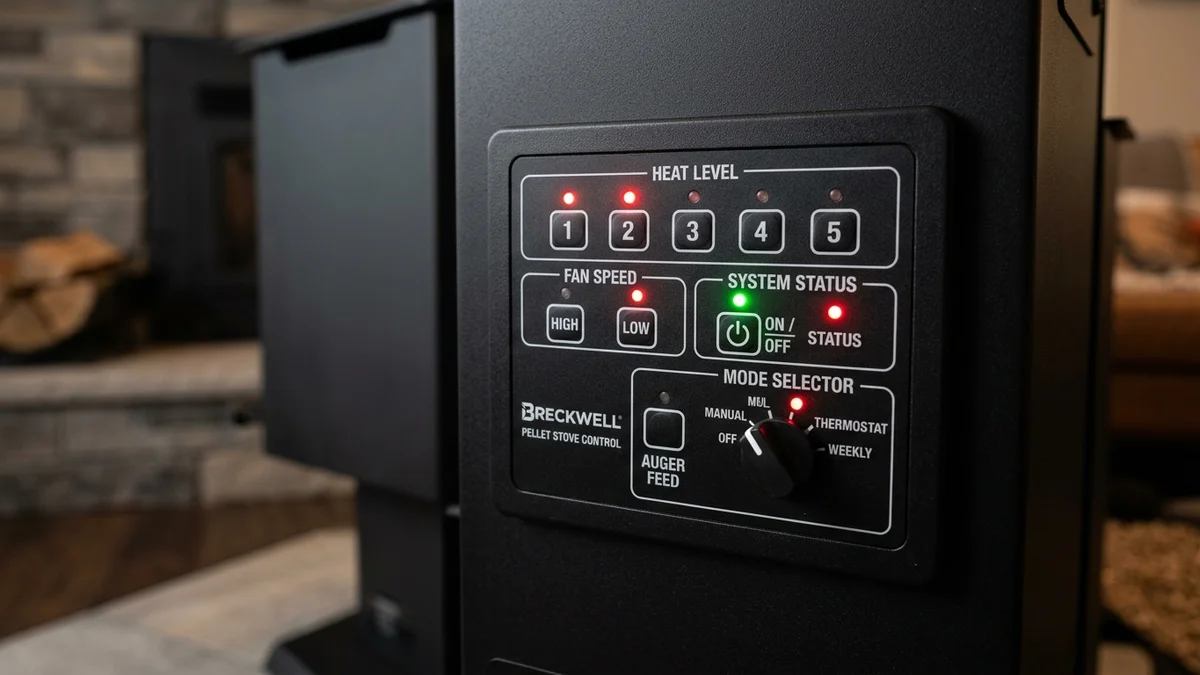
⚙️ Primary Operating Modes Explained:
- Manual Mode (Heat Levels 1–5): You manually select the desired heat level. Heat Level 1 runs the auger on minimum feed cycle for mild autumn evenings, while Level 5 pushes maximum fuel feed and blower speed for sub-zero winter nights.
- High / Low Thermostat Mode (Recommended): Connected to a standard low-voltage wall thermostat (such as a Honeywell or Nest millivolt circuit). When the room calls for heat, the stove runs at your selected high setting (e.g., Level 4). Once the room reaches target temperature, the stove drops down to a gentle maintenance pilot on Level 1, preventing the igniter from undergoing continuous cycling wear.
- On / Off Auto-Ignition Thermostat Mode: When the thermostat satisfies room temperature, the stove initiates a complete shutdown sequence. When the room cools down, the onboard hot rod auto-ignites a fresh fire. (Best suited for well-insulated modern homes in moderate climates).
For outdoor adventurers and campers who appreciate high-tech micro-combustion controls and solid-state thermoelectric generation, our review of the BioLite CampStove 2+ explores similar forced-air micro-jet technology on a portable wilderness scale.
4. Thermal Efficiency, BTU Output & Square Footage Performance
In thermal testing and real-world home installations, Breckwell pellet stoves demonstrate remarkable heating efficacy. According to clean heating and residential air quality standards overseen by the EPA Burnwise Program, EPA-certified pellet stoves achieve overall thermal efficiencies between 70% and 83%, with particulate emissions well below 2.0 grams per hour—making them vastly cleaner and more efficient than traditional open wood fireplaces or uncertified cordwood stoves.
| Breckwell Model | Max BTU Output | Heating Area (Sq. Ft.) | Hopper Size | EPA Overall Efficiency | Max Burn Duration |
|---|---|---|---|---|---|
| Big E (P1000) | 55,000 BTU/hr | Up to 2,200 sq. ft. | 120 lbs (3 bags) | 78.5% | 60 – 80 Hours |
| P24 Executive | 50,000 BTU/hr | Up to 2,200 sq. ft. | 60 lbs (1.5 bags) | 81.0% | 30 – 45 Hours |
| P22 Maverick | 40,000 BTU/hr | Up to 1,500 sq. ft. | 45 lbs (1 bag) | 79.0% | 24 – 35 Hours |
| P4000 Sonoma | 42,000 BTU/hr | Up to 1,800 sq. ft. | 55 lbs (1.3 bags) | 80.5% | 28 – 40 Hours |
When operating in sub-zero winter temperatures, a single Breckwell Big E operating on Heat Level 3 can comfortably sustain a 72°F interior climate across a 2,000 sq. ft. two-story home, displacing hundreds of gallons of expensive heating oil over a typical December-to-March heating season.
5. Hopper Capacities & Burn Times: From 45 lb Daily Fills to 120 lb Big E Endurance
In the pellet stove community, hopper size dictates lifestyle. With a standard 40 lb to 45 lb hopper (common on compact stoves like the P22 Maverick), homeowners must load a full bag of pellets every 24 hours during peak winter months.
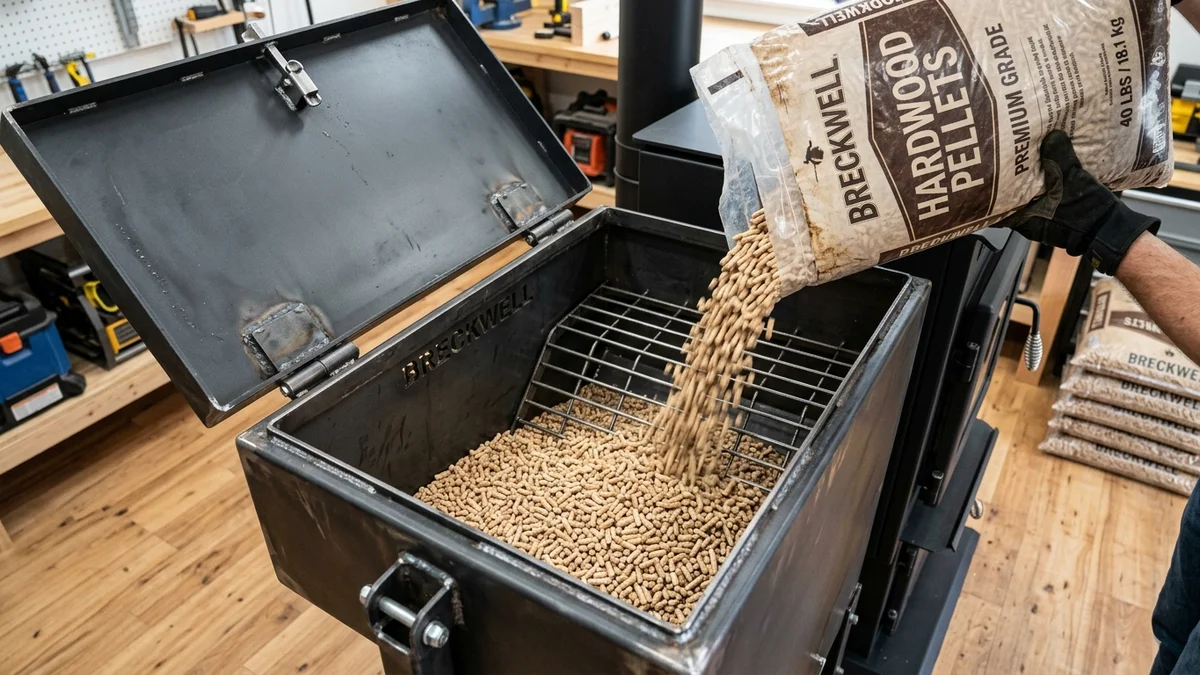
This is where the Breckwell Big E (P1000) establishes its legendary reputation. Its massive top hopper holds three entire 40 lb bags (120 lbs total) of wood pellets. When running on low-to-medium heat under thermostatic control, the Big E can operate continuously for 3 to 4 full days without requiring a single refill. For homeowners who work long hours, travel for weekend ski trips, or use pellet stoves to protect off-grid cabins from freezing pipes, this hopper capacity is a game-changing luxury.
6. Routine Maintenance Protocol: Burn Pot Clinkers, Scraper Rods & Ash Pan
While pellet stoves offer automated fire management, they are mechanical appliances that require regular maintenance to maintain optimal air-to-fuel combustion ratios:
- Daily Routine (2 Minutes): Pull and push the front heat exchanger scraper rod 4 to 6 times to knock loose fly ash into the lower pan. Visually inspect the flame through the glass.
- Weekly Routine (10 Minutes): Shut down the stove and allow it to cool completely. Lift out the cast-iron burn pot, scrape out hard silica “clinkers” (melted mineral impurities in pellets), clear the perforated air holes with a small wire brush, vacuum the firebox floor with a dedicated HEPA ash vacuum, and wipe the ceramic glass door with a damp paper towel dipped in wood ash.
- Monthly Routine (15 Minutes): Slide out the lower high-capacity ash pan and empty it into a fireproof steel ash bucket. Clean the drop chute area above the burn pot.
- Annual Seasonal Overhaul (60 Minutes): Disconnect exhaust venting, vacuum the combustion blower housing, brush the rear flue passage, inspect door fiberglass rope gaskets for a tight dollar-bill seal, and lubricate blower motor bearings if applicable.
Adhering to solid fuel safety protocols established by the National Fire Protection Association (NFPA), always maintain minimum clearances to combustibles (typically 3 inches from rear walls and 6 inches from side walls when using double-wall certified Type L pellet vent pipe) and install dual photoelectric smoke and carbon monoxide detectors in adjacent living areas.
7. Troubleshooting Common Breckwell Issues: Vacuum Switches, Auger Jams & E-Codes
Like all electro-mechanical heating systems, Breckwell stoves can encounter operational hiccups over years of service. Understanding the most common symptoms and their fixes will save you expensive service calls:
🔧 Symptom: Auger Stops Feeding Pellets
- Low Vacuum Pressure: The stove’s safety vacuum pressure switch shuts off auger power if it detects inadequate negative draft. Check for a loose door latch, worn rope gasket, clogged flue cap, or a cracked clear silicone vacuum hose.
- Hopper Pellet Bridging: Long pellets can catch and create a hollow “bridge” over the auger intake. Stir the hopper and use standard 1-inch pellets.
- High Limit Snap Disk Tripped: If the convection fan is clogged with dust, the firebox overheats and trips the 200°F high-limit switch, halting auger operation.
🔥 Symptom: Lazy, Sooty Yellow Flame
- Clogged Burn Pot Holes: Ash and carbon crust block oxygen intake ports. Remove and scrape the cast iron pot thoroughly.
- Combustion Blower Ash Build-up: Fly ash accumulation on the exhaust fan impeller reduces air draw. Clean the exhaust fan blades annually.
- Damper Adjustment Needed: Adjust the manual combustion air damper rod on the stove side to increase primary air until the flame burns crisp, active, and torch-like.
For culinary enthusiasts interested in temperature stability and burner precision across kitchen appliances, explore our detailed guides on what temperature is simmer on an electric stove and gas vs electric vs induction cooktops.
8. Head-to-Head Comparison: Breckwell vs. Quadra-Fire vs. PelPro
To understand where Breckwell sits in the broader residential pellet stove ecosystem, let us contrast its flagship Big E / P24 against top market competitors:
| Metric / Feature | Breckwell Big E (P1000) | PelPro PP130-B | Quadra-Fire Outfitter II |
|---|---|---|---|
| Max Heat Output | 55,000 BTU/hr | 50,000 BTU/hr | 49,000 BTU/hr |
| Hopper Capacity | 120 lbs (3 Bags) | 130 lbs | 60 lbs |
| Heating Coverage | Up to 2,200 sq. ft. | Up to 2,500 sq. ft. | Up to 2,000 sq. ft. |
| Construction Grade | Heavy Welded Steel + Cast Pot | Stamped Plate Steel | Cast Iron Outer Shell |
| Control System | Digital 1–5 Pushbutton Board | Single Dial Thermostat | Programmable Wall Control |
| Replacement Parts Availability | Universal (Widely Available) | Good (Hearth & Home) | OEM Dealer Specific |
Breckwell’s greatest competitive advantage lies in open parts availability and modular serviceability. Unlike high-end European pellet stoves that require proprietary diagnostic tools and expensive brand-certified technicians, virtually every motor, sensor, igniter, and control board on a Breckwell can be sourced inexpensively online and replaced by a handy homeowner with basic tools in under 30 minutes.
9. Pros, Cons & Final Buying Verdict: Is a Breckwell Pellet Stove Worth It?
✅ Why Breckwell Excels (Pros)
- Immense Heating Output: Up to 55,000 BTUs easily heats 2,000+ sq. ft. homes.
- Industry-Leading Hopper (Big E): 120 lb capacity enables 60–80 hours of hands-off burning.
- Rugged Heavy-Duty Build: Cast iron firebox components built for decades of winter abuse.
- Easy DIY Serviceability: Universal replacement parts widely available without proprietary lockouts.
- Thermostat Compatibility: High/Low mode maintains steady temperature without igniter wear.
⚠️ Considerations (Cons)
- Audible Fan Noise on High: Level 5 blower produces noticeable hum in small rooms.
- Utilitarian Styling on Big E: Industrial aesthetic is better suited for basements or rustic dens.
- Requires Routine Ash Care: Burn pot requires scraping every 4 to 7 days for clean ignition.
The Bottom Line: If you are looking for an ultra-delicate, whisper-quiet designer showpiece with smartphone app controls, you may prefer a luxury European pellet stove. However, if your goal is uncompromising winter heating horsepower, immense multi-day hopper capacity, affordable fuel costs, and rugged mechanical dependability that you can service yourself for twenty years, a Breckwell Pellet Stove (especially the iconic Big E or P24 Executive) represents one of the most reliable and cost-effective home heating investments available on the market today.
Please Write Your Comments